


King's Messengers: Andrew Basilico (1782-1813) and William Ross (1765-1800)
 Born: ~1740 (1725 according to Slater Family Tree), London, England
Matthew Slater's marriage (PDF, 84 kB)
Matthew Slater's marriage (JPG, 521 kB)
Matthew Slater's will (PDF, 156 kB)
 Matthew Slater, born 1725, was a King's Messenger, travelling much in the
course of his work on the Continent. It is said that he eloped with his
future wife, Elizabeth Twells, from her school in Paris. They had thirteen
children. Of the children, we know something of Ann, Thomas, Juliana, Charles,
and Rachael Elizabeth, but nothing of any of the others, nor why there should
have been a second Matthew and a second George. The Gentlemen's Magazine of
1796 records the marriage of a daughter (no name given). As Juliana and Sarah
died young, and Ann and Rachael Elizabeth were spinsters, this must have been
Elizabeth.
Matthew Slater, born 1725, was a King's Messenger, travelling much in the
course of his work on the Continent. It is said that he eloped with his
future wife, Elizabeth Twells, from her school in Paris. They had thirteen
children. Of the children, we know something of Ann, Thomas, Juliana, Charles,
and Rachael Elizabeth, but nothing of any of the others, nor why there should
have been a second Matthew and a second George. The Gentlemen's Magazine of
1796 records the marriage of a daughter (no name given). As Juliana and Sarah
died young, and Ann and Rachael Elizabeth were spinsters, this must have been
Elizabeth.The job of a King's Messenger was that of a diplomatic courier, hand-carrying important and secret documents around the world. Purists say that the history of the sovereigns' messengers goes back to 1199, but the first known messenger was John Norman, who in 1485 earned 4d (1.5p) per day for carrying the state papers of Richard III.
The silver greyhound on the messenger's badge dates back to Charles II. In 1660, during his exile at Breda, Netherlands, Charles II issued a declaration of amnesty to all those who had opposed him and his father. He used messengers to make his intentions known.
In answer to the messenger's question "How will they know me?", Charles reached forward to a silver bowl on the table in front of him. This bowl, with four decorative greyhounds standing proud above the rim, was well known to all courtiers. Charles broke off a greyhound and gave it to the messenger as a guarantee that the message came from him. From that date, the King's Messenger always wore a silver greyhound around his neck. Later, dating from George II or III, a badge with the Royal Arms in enamel, with the greyhound suspended beneath, was worn. A George III example of the King's Messenger Badge, pre 1800, sold for over 30 000 pounds some years ago.
To each of these messengers the king gave a small silver greyhound. He broke them from a dish which his father had owned and which would have been readily recognised by royalists. Thus the greyhound became the symbolic token of the messenger's loyalty. It is worn with a ribbon on formal occasions (and with an exclusive tie in modern times). The silver greyhounds were minted for each new reign, except the brief one of King Edward VIII.
The sovereign's messengers were originally controlled by the Lord Chamberlain, being Messengers of the Great Chamber. When the Foreign Office was created in 1782, the messengers remained common to the three Secretaries of State. Until 1822, the Foreign Office messengers were under the control of the Foreign Office Librarian, but by 1824 they were within the Home Service and Foreign Service Messengers Department.
The number of Messengers was 27 in 1995, and 15 in about 2005.
http://en.wikipedia.org/wiki/Queen%27s_Messenger
http://findarticles.com/p/articles/mi_m2242/is_n1574_v270/ai_19420280/
http://gmic.co.uk/index.php?showtopic=38371
According to "The History of the King's Messengers" published in 1935 by
V. Wheeler-Holohan,
the following people served as King's Messengers during the period when
Matthew Slater was a King's Messenger:
Daniel Ardouin,
Andrew Basilico 1782-1813,
William Bassett,
Benjamin Bathurst (nine days only),
James Dickens,
Thos East,
Thomas Fisher,
Lewis Hertslet,
Ralph Heslop,
Richd Johnson,
John Mason,
John Proudman,
William Ruffe,
William Ross 1765-1800,
John Schaw,
Charles Sylvester,
William Tims,
Nathaniel Vick,
George Walsh,
Thos Wiffin.
The following died on duty during that period:
Samuel Brooks,
(Thomas Brown?),
William Flint,
George Lyell,
John Magistri,
George Sparrow.
I have listed these names here, in the hope that other family history
researchers will find this page and make contact.
A King's Messenger in 1795 received a salary of 60 pounds per annum.
King's Messengers: Andrew Basilico (1782-1813) and William Ross (1765-1800)

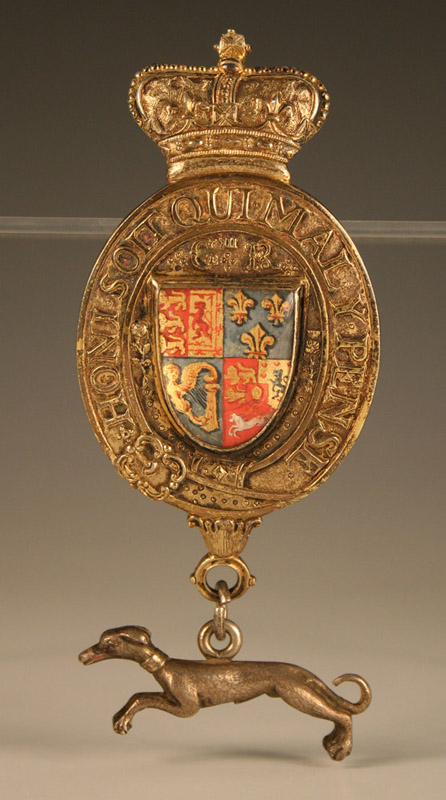
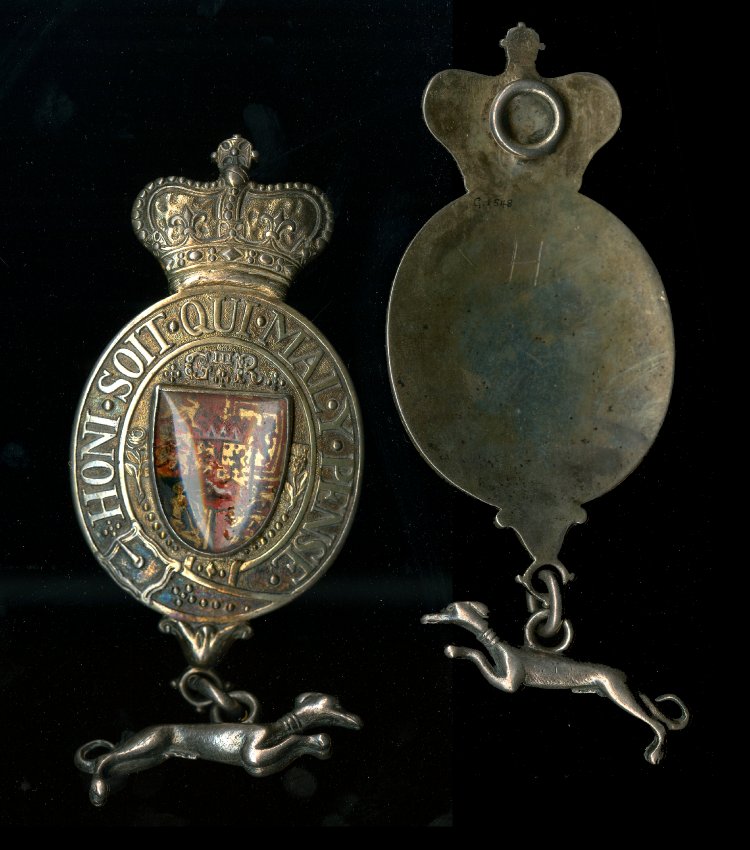
Picture 1: The badge of a King's Messenger during the reign of King George III
http://www.theparishcouncil.org/history/The_Basilicos_of_Langar,_Colston_Bassett_and_Beyond.pdf
Picture 2: A George III silver gilt King's Messenger's badge of oval form with
crown surmount, modelled with a garter, inscribed 'Honi Soit Qui Mal Y Pense',
framing a glazed panel, painted with the Royal flag, hung with a greyhound
pendant, unmarked, height approx 12.5cm.
http://www.tooveys.com/lots.asp?WEBLOTID=122030&LOTID=3260
Picture 3: British Museum -
King's Messenger's badge; silver gilt; oval; royal crown; garter motto
enclosing shield with royal arms painted under crystal; monogram; rose
and thistle; silver greyhound with hallmark; attached by loops at bottom.
Diameter: 4.54 inches
http://www.britishmuseum.org/research/search_the_collection_database/search_object_details.aspx?objectid=77365&partid=1&output=Places%2F!!%2FOR%2F!!%2F42362%2F!%2F42362-1-3%2F!%2FEmblem+of+England%2F!%2F%2F!!%2F%2F!!!%2F&orig=%2Fresearch%2Fsearch_the_collection_database%2Fadvanced_search.aspx¤tPage=3&numpages=10
In 1795 Matthew was appointed Senior King's Messenger, and an Expense Account for a journey to St Petersburgh and back, rendered on November 10th, 1795, has survived:
Despatched with 3 horses from Whitehall to St. Petersburgh.
To my journey from London to Yarmouth - being 136 miles at 1/6 per mile 9-9-0.
To 12 stages at 2d per stage and turnpikes 1-10.
Paid for passage from Yarmouth to Cuxhaven 3-13-0.
To 7 days on passage at 10/o per day 3-10-0.
To posting from Cuxhaven to Hanover by Berlin 19-10-0.
To 183 stages at 2d per stage and 30 days living 33-6-0.
To Ponts Barriers and crossing rivers this journey 4-10-0.
To safeguards and extra guides through Courland and Livonier 5-10-0.
To loss of money by exchange 4-10-0.
To attendance at St. Petersburgh for 5 days 11-10-0.
Despatched back with 3 horses from St Petersburgh to Whitehall 16-8-8.
To extra boat to land me at Yarmouth 10/6
To extra expenses crossing in boat etc on account of the sea 5-5-0.
I have examined the bill as for 491-9-6
Richd Ancell
I allow the bill
(signed) Greville.
Receipt signed Matthw Slater.


Portraits of King George III by Thomas Gainsborough, 1781
http://www.the-athenaeum.org/art/list.php?m=a&s=du&aid=1581
http://www.thomas-gainsborough.org
http://www.dmoz.org/Arts/Art_History/Artists/G/Gainsborough,_Thomas/